Flagging Developability Risk Across a Clinical mAb Panel — With No False Positives
In Collaboration with:

71
Clinical mAbs profiled
8
μg of material per replicate
6/0
true positives / false positives
3
replicates per antibody
How To Read This
Liquid State Intelligence™ generates a rich, high-dimensional signal from each sample, and different features within that signal may carry different information about molecular behaviour. Fully characterising antibody behaviour will require developing and validating each feature in turn, building the models needed to interpret and present that complexity clearly. This work is progressing feature by feature. VIBE1 is the most developed feature and is the focus of this study. The results here therefore represent one dimension of what Liquid State Intelligence™ can ultimately provide, not the complete picture. Further features are in active development and will be the subject of future work.
About Liquid State Intelligence™
Liquid State Intelligence™ is Apoha's measurement platform for capturing how molecules behave under real-world stresses, where performance actually matters. Most tools measure one isolated property at a time. Liquid State Intelligence delivers a small sample onto a specially engineered liquid surface and reads the waves that result, delivering a behavioural picture of that molecule in a single measurement, from as little as 10µg of material.
Developability failures happen late because early-stage tools don't capture the full picture of how a molecule will behave under real conditions. Liquid State Intelligence gives R&D teams a single high-dimensional readout sensitive to aggregation tendency, hydrophobicity, stability, and more, from one measurement, as early as hit identification. Apoha's platform eliminates candidates destined to fail with high precision, so the molecules that continue down the development pipeline are the ones most likely to reach patients.
Applied to antibodies, each droplet impact subjects the molecules to a transient, high-shear coalescence event that simultaneously imposes interfacial expansion, Marangoni-driven surface compression, axial elongational flow, and a sharp chemical-potential gradient, a single mechanically and chemically resolved probe of behaviours linked to aggregation, surface activity, viscosity and self-association.
Customer Background
Boehringer Ingelheim is one of the world's largest research-driven pharmaceutical companies, with over 52,000 employees focused on discovering and developing treatments for serious unmet medical needs in humans and animals. Innovation is core to how they work, and biological medicines, including antibodies, are a key part of their pipeline. Due to the high risk and failure rate in pharma, a large number of projects must run simultaneously, creating constant pressure to prioritise and make faster decisions with limited data.
The drug discovery pipeline carries very high R&D costs and long development timelines. Material is expensive per mg, which limits how much testing can be done and makes characterisation a costly stage. The mean cost of developing a new drug is estimated at $172.7 million, rising to $515.8 million once the cost of failures is included, meaning roughly two thirds of the total cost of drug development comes from failure.
Late-stage failure in antibody development is often driven by poorly understood developability and biophysical profiles. Current characterisation is slow, low-throughput, and material-intensive, forcing teams to work with limited and delayed data. Critically, this characterisation measures individual physicochemical attributes, they do not capture how an antibody behaves. As Michael Marlow, Director of Biologics CMC Research at BI puts it: behaviour is actually what drives developability, and behaviour is far more complex than the attributes conventional characterisation can measure.
The Challenge
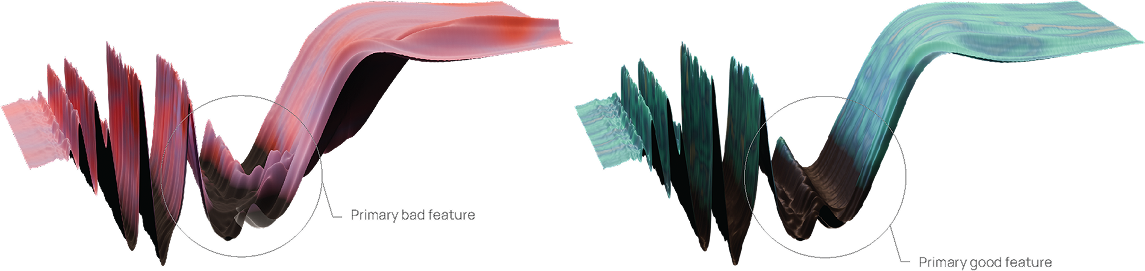
Can a single behavioural measurement actually flag the candidates a multi characterisation panel would later reject?
During drug development, many candidates must be carried forward because teams don't have the right information on behaviour early enough to make effective selections. Developability screening gives only a limited picture — conventional analysis require large amounts of material, forcing a constant compromise between the depth of data and the cost of testing. These measurements only measure a handful of individual properties and cannot capture how an antibody truly behaves.
“Apoha's technology works with practically no material, the biggest limitation at early stages, and it not only lets us detect liabilities earlier but also gives us additional insights beyond everything else we already have. That makes it incredibly easy to adopt into our workflow.”
How Characterisation Was Applied
Apoha measured how each antibody behaves under controlled stress, generating a unique fingerprint for each one. These fingerprints were first categorised into high or unknown developability risk, and then validated against BI's existing characterisation results.
BI provided ~70 antibodies from an internal discovery programme. Each sample was run in triplicate, using just 8 µg per replicate, 24 µg per antibody in total. Liquid State Intelligence™ requires a fraction of the material consumed by conventional characterisation, critical for early-stage programmes where material is scarce, expensive, and often the primary constraint on how much testing can be done.
Each sample was injected as a series of discrete droplets onto the Liquid State Intelligence™ sensing substrate, generating a unique time-evolving waveform response. Two reference antibodies, trastuzumab and sirukumab, were used to define the developability risk threshold, representing a developable and non-developable antibody respectively. These responses are quantified as VIBE™: Variations of Interfacial Behaviour and its Evolution, features extracted from the evolving signal. VIBE feature vectors are computed as statistical metrics that classify attributes of waveforms, broadly characterising the amplitude of the signal and its evolution during titration. Once VIBE1 classification was complete, results were validated against BI's characterisation panel: nonspecific binding, HIC, Tm, and SINS.
Results, Outcomes and Key Data
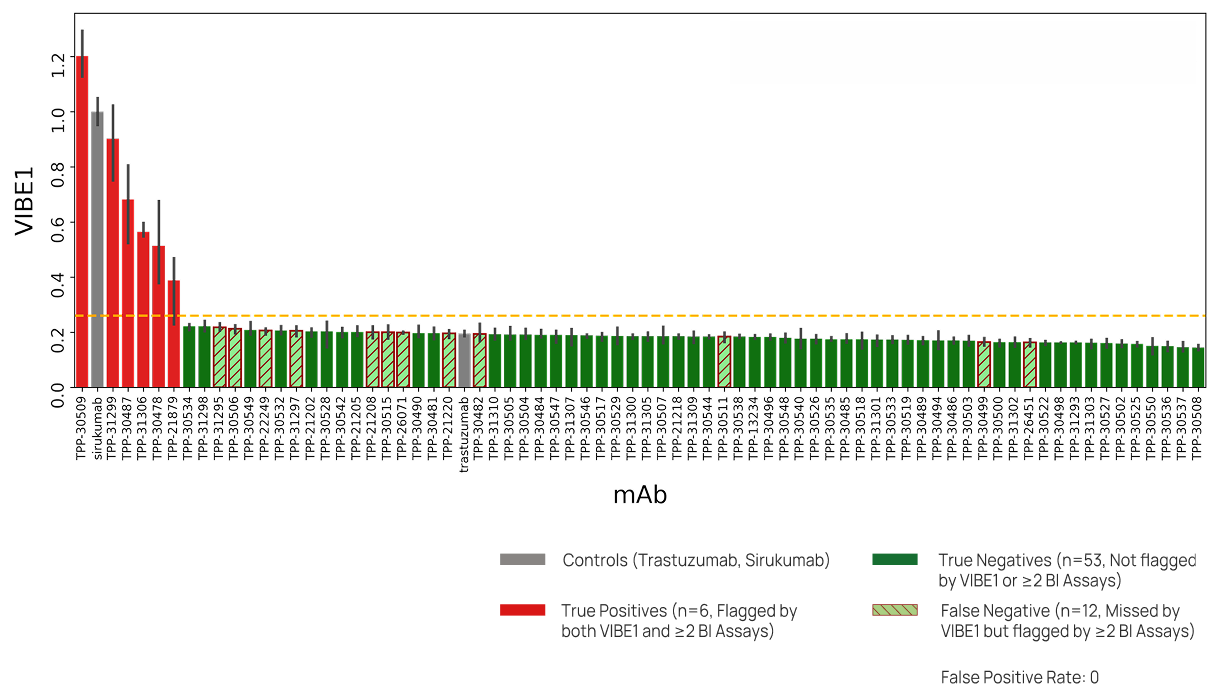
Liquid State Intelligence™ correctly identified 6 antibodies as high development risk, with no false positives. While 12 antibodies flagged by conventional characterisation were not captured, this is expected at this stage, the system is currently using only one of its available features.
For a company managing 60 active programmes, the ability to flag developability risk with no false positives and with minimal material volume means resources are not wasted pursuing candidates that will later fail, and decisions can be made with greater confidence earlier.
Figure 1 shows each sample/antibody as a bar, with a height corresponding to their VIBE1 value, which indicates variability in the signal response. The grey bars are the reference antibodies; the horizontal dashed orange line shows the threshold for high and low VIBE — above this line indicates developability risk. The bars are colour coded to show the correlation between the VIBE1 value and the characterisation results from BI: red showing 2 or more flags from the measurements and a high VIBE flag from Liquid State Intelligence™; green shows low VIBE score and fewer than 2 measurements flags; green with red dashed lines shows a low VIBE score but with 2 or more measurements flags. The confusion matrix (Figure 1b) shows classification results after applying the VIBE1 threshold.
Figure 1 shows each sample/antibody as a bar, with a height corresponding to their VIBE1 value, which indicates variability in the signal response. The grey bars are the reference antibodies; the horizontal dashed orange line shows the threshold for high and low VIBE — above this line indicates developability risk. The bars are colour coded to show the correlation between the VIBE1 value and the characterisation results from BI: red showing 2 or more flags from the measurements and a high VIBE flag from Liquid State Intelligence™; green shows low VIBE score and fewer than 2 measurements flags; green with red dashed lines shows a low VIBE score but with 2 or more measurements flags. The confusion matrix (Figure 1b) shows classification results after applying the VIBE1 threshold.
Key Finding
Liquid State Intelligence™ correctly identified 6 antibodies as high development risk with no false positives, using only 8 µg of material per replicate. The 12 false negatives reflect the current single-feature scope, each additional VIBE feature will expand coverage.
The Bottom Line
The ability to flag developability risk with no false positives, using a fraction of the material required by conventional characterisation, means fewer candidates need to be carried forward on incomplete data, and the cost of late-stage failure is reduced.
Next Steps
Boehringer Ingelheim and Apoha are continuing to develop this project together. The next phase will expand the number of antibodies tested and develop further Liquid State Intelligence™ features beyond VIBE1.
Expanding the dataset will improve the ability to identify developability risk earlier and with greater coverage. Each additional VIBE feature adds a new dimension of behavioural information, meaning fewer candidates need to be carried forward on incomplete data. For companies managing large portfolios, more information per molecule earlier in discovery has the potential to significantly reduce the cost and risk of late-stage failure.
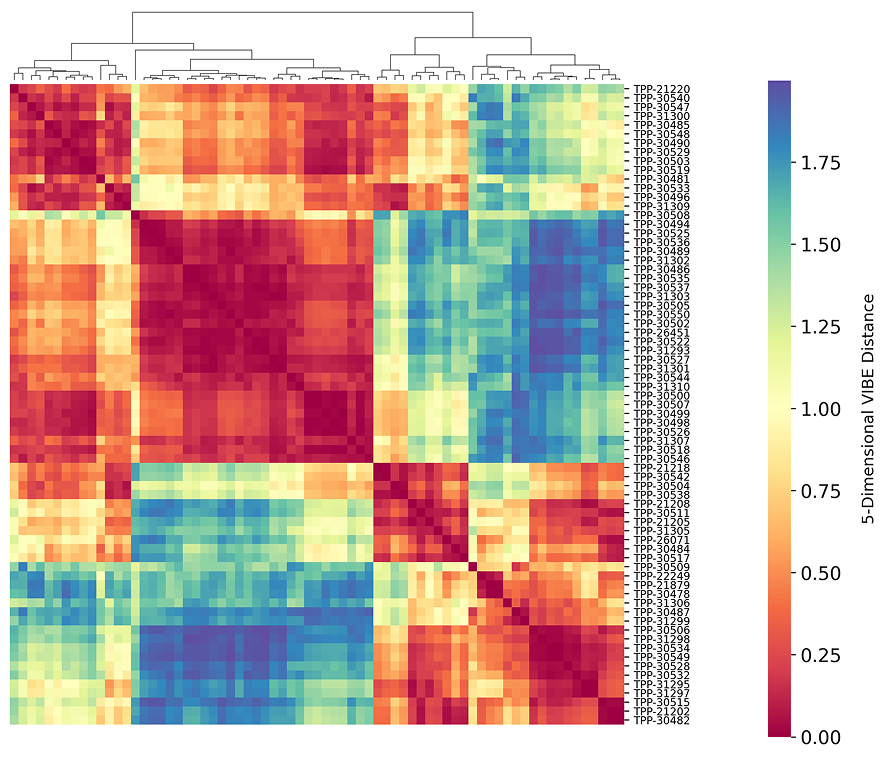
A single 8 µg measurement encodes far more than what a single feature can extract. VIBE2-5 are in active validation, each targeting an orthogonal axis of developability risk. The data below previews what is already present in the signal: VIBE1's outliers (in red) recover cleanly within the multi-dimensional fingerprint, alongside additional behaviourally distinct clusters that VIBE1 alone would not surface – including a strong candidate cluster in VIBE2 that maps to several of the 12 antibodies VIBE1 missed. Further validation across larger panels will establish thresholds for VIBE2–5 and build the models needed to interpret the full multi-dimensional fingerprint.
.svg)