Validating VIBE for Developability Risk Ranking in a Proprietary VHH-Fc Panel
Abstract
Finding the right antibody candidate early is one of the hardest problems in drug development. Working with Mythic Therapeutics, Apoha screened 71 proprietary VHH-Fc antibody candidates. VHH-Fc antibodies are a heavy-chain-only antibody format. They lack the light chains present in conventional IgG antibodies, and the developability tools and benchmarks established for IgG do not transfer simply to this format but requires a validated basis for early candidate selection. Screening a large panel of structurally complex proprietary antibodies for development risk typically requires multiple tests and significant material. Using just 8 µg per sample, Apoha's Liquid State Intelligence™ platform measured how each candidate behaves under controlled stress and produced a single integrated behavioural readout, providing a new dimension of information to guide candidate selection. From a panel of 71 proprietary VHH-Fc candidates, VIBE flagged 7 high-risk samples, enabling customers to flag high-risk candidates at an earlier stage.
In Collaboration with:
.svg)
About Liquid State Intelligence™
Liquid State Intelligence™ is Apoha's measurement platform for capturing how molecules behave under real-world stresses, where performance actually matters. Most tools measure one isolated property at a time. Liquid State Intelligence delivers a small sample onto a specially engineered liquid surface and reads the waves that result, delivering a behavioural picture of that molecule in a single measurement, from as little as 10µg of material.
Developability failures happen late because early-stage tools don't capture the full picture of how a molecule will behave under real conditions. Liquid State Intelligence gives R&D teams a single high-dimensional readout sensitive to aggregation tendency, hydrophobicity, stability, and more, from one measurement, as early as hit identification. Apoha's platform eliminates candidates destined to fail with high precision, so the molecules that continue down the development pipeline are the ones most likely to reach patients.
Applied to antibodies, each droplet impact subjects the molecules to a transient, high-shear coalescence event that simultaneously imposes interfacial expansion, Marangoni-driven surface compression, axial elongational flow, and a sharp chemical-potential gradient, a single mechanically and chemically resolved probe of behaviours linked to aggregation, surface activity, viscosity and self-association.
Customer Background
Mythic Therapeutics is a clinical-stage biotechnology company developing antibody-drug conjugates (ADC) that deliver a therapeutic payload directly to tumour cells. Selecting the right antibody candidate early is critical.
Drug development is expensive and time-consuming. Identifying which candidates are most likely to fail early is one of the most valuable decisions in drug development programme. For the VHH-Fc format, where established developability benchmarks are limited, that call is harder to make with confidence.
Running a full panel of single-property measurements across a large candidate set is material-intensive and costly. Hydrophobic Interaction Chromatography (HIC) is one of the standard methods used to screen antibody candidates for hydrophobicity, measuring retention time as a proxy for surface-exposed hydrophobic character. It captures a single property and provides a continuous score, with no established classification threshold for the VHH-Fc format.
The Challenge
For drug developmet, large candidate panels need reliable ranking for development risk, but conventional developability assays each measure a single property in isolation, and for formats like VHH-Fc, established benchmarks remain limited, leaving teams without a clear pass/fail.
Liquid State Intelligence™ correctly flagged liabilities between antibodies that differed by just 1–2 amino acids! Based on these results, we’re now integrating Liquid State Intelligence™ at the very start of our next program to get developability insights right at hit identification.
How Characterisation Was Applied
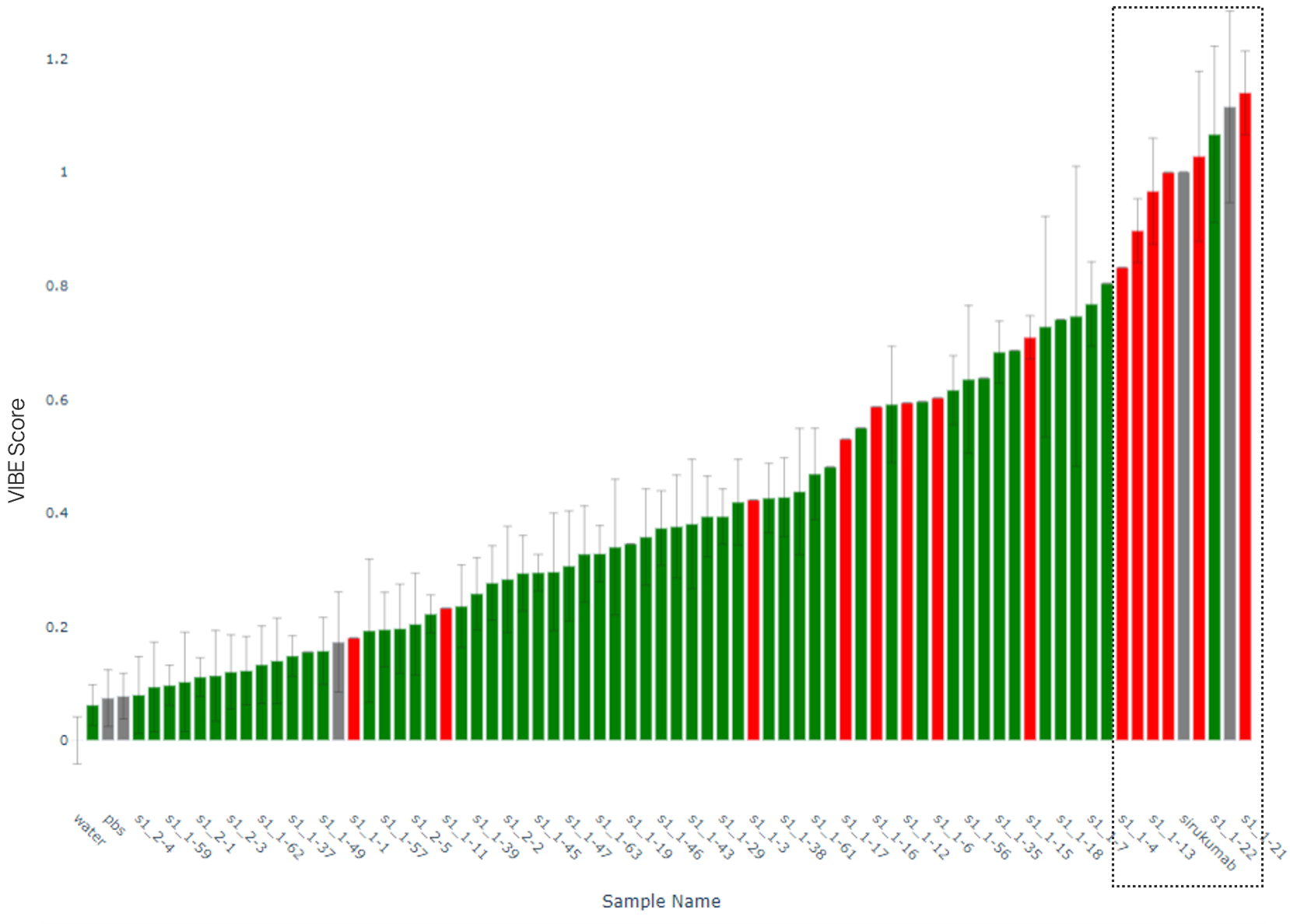
Apoha tested all 71 proprietary VHH-Fc antibody candidates on its Liquid State Intelligence™ Platform (LSIP) and ranked them by their VIBE feature score. The top 10% of samples were flagged as high-risk antibody candidates.
The study was designed so that Apoha measured all samples blind, with no prior knowledge of HIC outcomes. Mythic provided HIC retention data for 69 of the 71 samples, enabling a correlation analysis between VIBE scores and HIC outcomes. Each candidate was measured at 8 µg per injection, and VIBE was extracted as a single integrated feature summarising each candidate's behavioural profile.
Samples were prepared in PBS buffer at a final concentration of 0.1 mg/ml and measured at room temperature on the LSIP in triplicate. Well-characterised reference antibodies were included to calibrate the VIBE threshold: trastuzumab as a low-risk control and sirukumab and urelumab as high-risk controls. All 71 candidates were ranked by VIBE score and the top 10% were flagged as elevated development risk.
No additional data processing was applied prior to VIBE extraction. UV absorbance was monitored across samples and fell within a 20% variance range, confirming consistent sample quality.
Reference antibodies and VHH-Fc candidates were both measured at 0.1 mg/ml. Due to differences in molecular weight between IgG-format reference antibodies and VHH-Fc candidates, this represents a slightly different molar concentration across the two formats. This difference was assessed and confirmed as negligible for the purposes of this ranking, as the analysis focused on relative ranking within the VHH-Fc panel rather than direct cross-format comparison.
Results, Outcomes and Key Data
Apoha's Liquid State Intelligence™ platform demonstrates that a single feature, VIBE, can identify high-risk VHH-Fc candidates. VIBE results were benchmarked against the industry standard, HIC retention data provided by Mythic. VIBE flagged 7 samples as high risk, 10% of the panel. Six of them matched with the bottom 20% of Mythic's HIC panel, an 86% precision rate.
Finding 1 - Precision VIBE flagged 7 candidates as high risk. Six of these were independently confirmed by HIC retention data, giving a precision of 86%. This level of agreement between two independent methods provides a strong basis for candidate selection decisions. One false positive was identified.
Finding 2 – Specificity Of the 64 samples VIBE did not flag, 56 aligned with the low-risk portion of the HIC panel, giving a specificity of 98%. Candidates not-flagged by VIBE are unlikely to carry elevated development risk. Eight false negatives were identified based on the bottom 20% of the HIC panel.\
Finding 3 - Independent flagging. All samples were measured blind with no prior knowledge of HIC outcomes or sequence information. VIBE measures interfacial behavioural response and HIC measures surface hydrophobicity. These are two physically distinct measurement approaches. Their agreement on high-risk candidates strengthens confidence in the finding.
Finding 1 - Precision VIBE flagged 7 candidates as high risk. Six of these were independently confirmed by HIC retention data, giving a precision of 86%. This level of agreement between two independent methods provides a strong basis for candidate selection decisions. One false positive was identified.
Finding 2 – Specificity Of the 64 samples VIBE did not flag, 56 aligned with the low-risk portion of the HIC panel, giving a specificity of 98%. Candidates not-flagged by VIBE are unlikely to carry elevated development risk. Eight false negatives were identified based on the bottom 20% of the HIC panel.\
Finding 3 - Independent flagging. All samples were measured blind with no prior knowledge of HIC outcomes or sequence information. VIBE measures interfacial behavioural response and HIC measures surface hydrophobicity. These are two physically distinct measurement approaches. Their agreement on high-risk candidates strengthens confidence in the finding.
Next Steps
This study establishes VIBE as an orthogonal measure alongside conventional developability methods. Testing additional VHH-Fc candidates will strengthen the signal and build confidence in the findings.
Expanding the dataset will build a stronger foundation for understanding VIBE's performance across diverse VHH-Fc candidates. Correlating VIBE features with provided descriptors, both biophysical and in silico, will help identify where VIBE is most complementary to existing methods.